
Mitsubishi Certified Pre-Owned: An Overview
You’re standing on a used lot in Freeport, looking at two nearly identical Mitsubishi SUVs. Same body style, same color family, same trim feel. One is priced a little higher because of a gold Certified Pre-Owned badge, and the question is simple, does that badge change what you own, or just what you pay today?
For a first-time buyer on Long Island, that’s the decision. Mitsubishi Certified Pre-Owned is not just dealer language for a nice used car, it’s a manufacturer-backed program with an inspection, eligibility rules, and warranty coverage that can change your repair exposure in a very real way. The value isn’t abstract, it shows up later, when a part fails, when you need roadside help, or when you go to trade the vehicle back in.
Table of Contents
- What a Mitsubishi Certified Pre-Owned Car Actually Is
- How the 123-Point Inspection and Eligibility Work
- Understanding the CPO Warranty Stack
- Mitsubishi CPO vs a Regular Used Car
- Why CPO Inventory Matters More Than Discounts in 2026
- How South Shore Mitsubishi Handles Certified Sales
- Common CPO Misconceptions and a Buyer’s Checklist
What a Mitsubishi Certified Pre-Owned Car Actually Is
A shopper can walk the South Shore lot, see a 2021 Outlander Sport, and then spot a nearly identical model with a CPO badge and a slightly higher price. That difference makes sense once you know what the badge means. A Mitsubishi Certified Pre-Owned vehicle is still a used vehicle, but it has passed a manufacturer-required inspection and reconditioning process and has met the program’s eligibility rules described in Mitsubishi’s CPO brochure, including being within the last 5 model years and having fewer than 60,000 miles. The official brochure also says every eligible vehicle gets a 123-point inspection and a Vehicle History Report to screen for known repair and accident history. Mitsubishi CPO brochure
That matters because CPO is different from “dealer inspected.” A normal used car can be cleaned, priced, and parked on the front line without the factory-level process Mitsubishi uses for certified units. A factory-backed CPO vehicle is tied to Mitsubishi’s own standards and warranty structure, not just a sales pitch from the store.
What the badge changes for the buyer
The biggest change is the warranty stack. Mitsubishi says certified buyers receive the balance of the original new-vehicle powertrain warranty, commonly described as 10 years/100,000 miles from the original in-service date. The clock starts when the vehicle was first sold, not when you buy it certified. Mitsubishi CPO brochure
That detail is easy to miss, and first-time shoppers often mix it up. A CPO car is not a new car, and it is not a third-party warranty package attached to a used car after the fact. It is a used Mitsubishi that kept part of its factory protection because it met the program’s rules.
A simple way to judge the value is to ask what risk you are buying. If two SUVs look almost the same on the lot, the CPO one is a different product once you factor in inspection standard, warranty timing, and resale protection.
For a Long Island buyer, that distinction usually matters more than the badge itself. A low-mileage certified Outlander Sport is not just a nicer used SUV, it is a lower-risk version of the same vehicle with a paper trail and manufacturer coverage behind it.
How the 123-Point Inspection and Eligibility Work
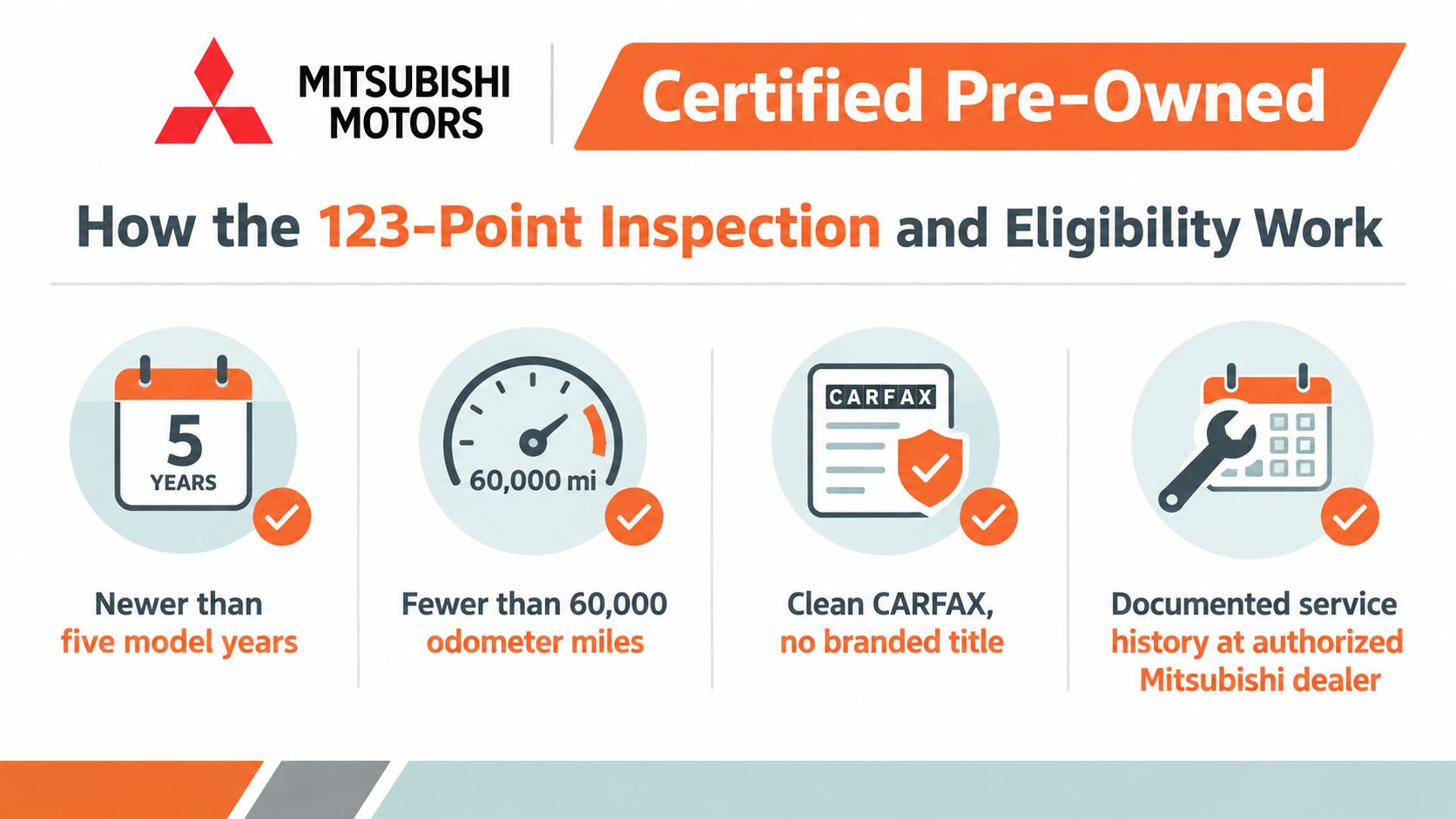
A CPO badge starts with a gate, not a display tag. Mitsubishi limits certified inventory to vehicles that fall within the approved model-year and mileage range, then requires a 123-point inspection and a Vehicle History Report before the car can wear the certified label. That is why a clean-looking trade-in is not automatically eligible.
For a first-time buyer, the easiest way to read that process is by category. The inspection begins with the parts that decide how the car performs on the road, the engine, transmission, and other systems that affect smooth operation and long-term reliability.
It also covers safety and electrical function. Those are the systems that help the vehicle stop, light the road, warn the driver, and keep the electronics working the way they should after you leave the lot. Then the technician checks the overall condition of the vehicle itself, because certification is supposed to mean a carefully selected retail unit, not just one that starts and moves.
A strong CPO inspection asks more than whether the car runs. It asks whether the vehicle is ready for a customer’s driveway, not just a quick test drive.
History matters just as much as condition. A vehicle with complete records and a clearer paper trail is easier to evaluate, easier to recondition, and easier for the dealer to stand behind. That is one reason a well-documented service-loaner can sometimes be a better certified candidate than a trade-in with gaps in its story. Reconditioning is part of the process, not an extra courtesy.
If you are shopping at South Shore Mitsubishi in Freeport, ask to see the inspection report and the original window sticker. The report shows what was checked, and the window sticker helps you compare the vehicle’s original equipment with the certified unit in front of you.
That paper trail is value. If the dealer can show you the vehicle history packet, the inspection summary, and the original build information, you can judge the certification premium with more confidence.
Understanding the CPO Warranty Stack
The warranty is where Mitsubishi Certified Pre-Owned usually becomes easier to justify than a regular used car. Mitsubishi’s certified coverage is anchored to the original in-service date, and that timing changes the math for buyers who are looking at a newer, lower-mileage SUV. The core promise is the 10-year/100,000-mile powertrain limited warranty, plus the remainder of the original basic and anti-corrosion coverage, with 24-hour roadside assistance included in the U.S. for the duration of the limited warranty. Mitsubishi Certified Pre-Owned
How the layers work together
Think of the warranty as a stack instead of a single blanket. The powertrain layer is the one most buyers care about, because that’s where expensive failures live. The basic coverage layer matters if the car is still young enough to have time left on the original factory warranty. Roadside assistance is separate, but it can save a Saturday night from turning into a towing bill and a headache.
| Coverage Layer | Term | Example Repair | Estimated Out-of-Pocket Cost |
|---|---|---|---|
| Powertrain Limited Warranty | 10 years/100,000 miles from original in-service date | Engine, transmission, driveline repair | Covered if the failure falls under warranty |
| Remaining Original Basic Coverage | Only if the vehicle still has time left from first sale | An electrical or factory component issue | Covered if the issue is still within original terms |
| 24-Hour Roadside Assistance | For the duration of the limited warranty in the U.S. | Towing after a breakdown, lockout help | Reduced or avoided depending on the service needed |
The value shows up when something breaks. A transmission or driveline issue can be the kind of repair that makes a used-car owner wince. A CPO buyer is buying some insulation against that kind of surprise, especially on a vehicle that still has meaningful warranty time left because the coverage runs from the first in-service date.
What CPO does not mean
CPO does not mean everything is covered. Routine maintenance, wear items, and aftermarket modifications still sit outside the warranty safety net. Tires wear out. Brake pads wear down. Oil changes still happen. The warranty is there to protect against certain covered failures, not to turn ownership into a no-expense experience.
If you’re comparing two certified units, ask how much factory coverage is left. A newer vehicle with fewer months and miles on the original clock often gives you more usable protection than an older one that is still certified but already closer to the end of its factory timeline.
Use this rule: the closer the car is to the original in-service date, the more of the warranty stack you’re really buying with the vehicle.
The transferable nature of the certified coverage also matters later. When you trade the car in or sell it, a remaining factory-backed warranty can make the vehicle easier to explain and easier to value.
Mitsubishi CPO vs a Regular Used Car
A certified Outlander and a regular used Outlander can look almost identical from ten feet away. The difference shows up in the risk you’re taking home. On the wallet side, the certified unit usually costs more upfront, but part of that premium buys inspection, remaining warranty coverage, roadside assistance, and a cleaner history package.
The practical trade-off
| Factor | Mitsubishi CPO | Regular Used |
|---|---|---|
| Upfront price | Higher because of certification and added coverage | Lower at the sticker or listing stage |
| Repair risk | Lower exposure to certain covered failures | More repair risk rests with the buyer |
| History package | Vehicle history report included in the program | Varies by seller |
| Warranty protection | Factory-backed coverage remains in play | May be limited, expired, or nonexistent |
| Ownership confidence | More documentation and standardization | Depends on how the previous owner maintained it |
The question isn’t whether the used car is cheaper on day one. It’s whether you’d rather pay less now and absorb more uncertainty later, or pay a little more for a vehicle that comes with a tighter inspection process and factory-backed protection. For a commuter who depends on the car daily, that difference can be more important than the monthly sticker math suggests.
Where the premium makes sense
A CPO premium can be easier to justify when you’re buying a newer model with low miles and you plan to keep it a while. That’s because you’re not just paying for a clean presentation. You’re paying for reduced risk, documented certification, and remaining factory coverage that a private-party purchase usually can’t match.
A regular used car still has a place. If your budget is tight and you’re comfortable handling repairs as they come, the lower entry price may make sense. But if you’re comparing two similar SUVs and one is certified, the certified one is usually the more complete ownership package.
For shoppers who ask what they’re trading, the answer is simple. With CPO, you give up some upfront savings and get more certainty. With a regular used car, you keep more cash today and take on more of the repair uncertainty yourself.
Why CPO Inventory Matters More Than Discounts in 2026
The biggest misunderstanding around certified cars is that the best deal is always the cheapest one. In a tighter certified market, that’s not how value works. Mitsubishi’s CPO supply is a small slice of the used market, so the advantage often comes from getting a vetted vehicle at all, not waiting around for a steep markdown that may never show up.
That’s especially true in value-sensitive markets like Long Island, where buyers want a specific body style, color, mileage range, and trim. If the right certified Outlander or Eclipse Cross is on the lot, waiting for a “better deal” can mean losing the exact vehicle that fit your needs. CPO inventory is curated, not endless.
What scarcity does to the shopping experience
A small certified pool changes the conversation from discount hunting to selection quality. Buyers tend to focus more on whether the unit matches their use case, whether the warranty window is still useful, and whether the vehicle history is clean. That’s the right mindset for certified shopping, because a CPO car is only valuable if it’s the right car for you.
Scarcity also helps keep depreciation in check on well-sorted units. A freshly certified SUV with the right mileage and history usually stays more attractive than a loosely maintained used copy that looks cheaper on a listing site but brings more uncertainty to the driveway.
CPO shoppers who wait for a bargain often lose the better unit to someone who recognized the value of the paperwork, not just the price tag.
What that means for a Freeport buyer
A dealer like South Shore Mitsubishi in Freeport may only have a limited number of certified options at any given time, so speed matters more than with ordinary used inventory. If you find the right vehicle, your decision should be based on the inspection report, the remaining warranty, and the fit for your commute or family routine.
That doesn’t mean you should rush blindly. It means you should compare faster and smarter. If the certified vehicle checks out, the premium can be justified by the way it reduces ownership risk in a market where the best examples don’t sit forever.
How South Shore Mitsubishi Handles Certified Sales
The buying process gets a lot easier once the paperwork is organized. South Shore Mitsubishi keeps the certified search path practical for shoppers who want to compare cars before they drive in from another part of Long Island. The point is to see the right details early, not after you’ve spent half a day wandering a lot.
From browsing to paperwork
Start with the online certified inventory filters. That lets you narrow by model, mileage, price, and CPO status before you ever sit in the driver’s seat. For a first-time buyer, that saves time and keeps the search focused on cars that already fit your budget and size needs.
Once a vehicle looks promising, ask for the history packet. That should include the vehicle history report, service records if available, and the inspection summary so you can read the facts instead of relying on a sales pitch. After that, the in-store walkaround should cover the remaining warranty, any add-on protection options, and the financing conversation for certified models.
The cleanest certified deal is the one where the buyer sees the history, the inspection, and the warranty terms before discussing monthly payment.
Trade-in appraisal usually comes next. Use the dealership’s trade tools before you arrive if you want a realistic starting point, then confirm the number in person after the vehicle is evaluated. That helps you avoid mixing the value of your trade with the value of the certified vehicle itself.
What should be in the handoff
On delivery day, you should leave with the certified paperwork binder, the roadside assistance information, and a clear understanding of when the first scheduled service should happen. That matters because ownership starts with organization, not just keys.
You’ll also want to know which coverage came with the car, what was reconditioned, and what still falls under factory protection. A good certified sale makes that information easy to reference later. If you ever need to trade the vehicle back in, that documentation can help the next buyer trust the car the same way you did.
Common CPO Misconceptions and a Buyer’s Checklist
A lot of shoppers overpay for the wrong reasons because they buy into the wrong idea about certified cars. The first myth is that CPO is just a fancier used car. It’s not, because the inspection and warranty structure are different. The second myth is that every brand’s inspection is basically the same, but certification standards vary by manufacturer, so the badge alone doesn’t tell the full story.
The third myth is that CPO coverage matches new-car coverage. It doesn’t. The certified package protects specific systems and timing windows, while the rest of ownership still works like used-car ownership. The fourth myth is that CPO vehicles are automatically overpriced. Sometimes the premium is modest compared with the cost of one covered repair, but the decision still depends on the car’s actual condition and remaining coverage.
The fifth myth is that any Mitsubishi dealer offers identical terms on every certified unit. The program rules are the anchor, but the actual vehicle you’re looking at still has to qualify, and the remaining warranty depends on the original in-service date.
A quick buyer checklist
- Verify the inspection report. Ask to see the 123-point checklist and the reconditioning notes.
- Check the model year and mileage. Confirm the vehicle still fits the certified eligibility window.
- Review the vehicle history. Read the history report before you talk monthly payment.
- Understand the warranty terms. Ask how much factory coverage is left from the original in-service date.
- Compare two similar vehicles. If possible, look at a certified unit and a regular used one side by side.
- Ask about service records. A documented maintenance trail makes the car easier to trust.
- Schedule your own pre-purchase inspection if you want another layer of comfort. Even certified buyers can benefit from a second set of eyes.
A simple decision rule helps here. If the vehicle passes the inspection and the warranty checklist, the premium over a private-party used car is usually justified by the documented coverage and lower out-of-pocket exposure. If the paperwork is weak or the remaining factory coverage is thin, keep shopping.
If you’re comparing certified Outlanders, Eclipse Cross models, or any other Mitsubishi on Long Island, South Shore Mitsubishi can show you the inspection details, the warranty terms, and the trade-in process in one visit. Visit South Shore Mitsubishi to browse certified inventory, review the paperwork, and see whether a Mitsubishi Certified Pre-Owned vehicle fits the way you drive in Freeport and beyond.
0 comment(s) so far on Mitsubishi Certified Pre-Owned: An Overview