
Mitsubishi Outlander for Sale: A Local Buyer’s Guide
You’re probably comparing two or three Mitsubishi Outlanders right now, looking at the same monthly payment, and assuming the cheaper sticker wins. That’s the wrong way to shop this SUV. The question is which Outlander for sale gives you the lowest total cost after fuel, depreciation, service, warranty coverage, and resale are all counted.
The Outlander has earned staying power in the U.S. market, with annual sales climbing from 11,848 in 2005 to 23,285 in 2007, then rising again from 19,055 in 2015 to 37,965 in 2019 and 45,253 in 2024, its best-ever sales year, according to GoodCarBadCar’s Outlander sales history. That matters because a model with real demand tends to be easier to live with, easier to resell, and easier to understand in the used market. It also tells you the nameplate has legs, not just showroom appeal.
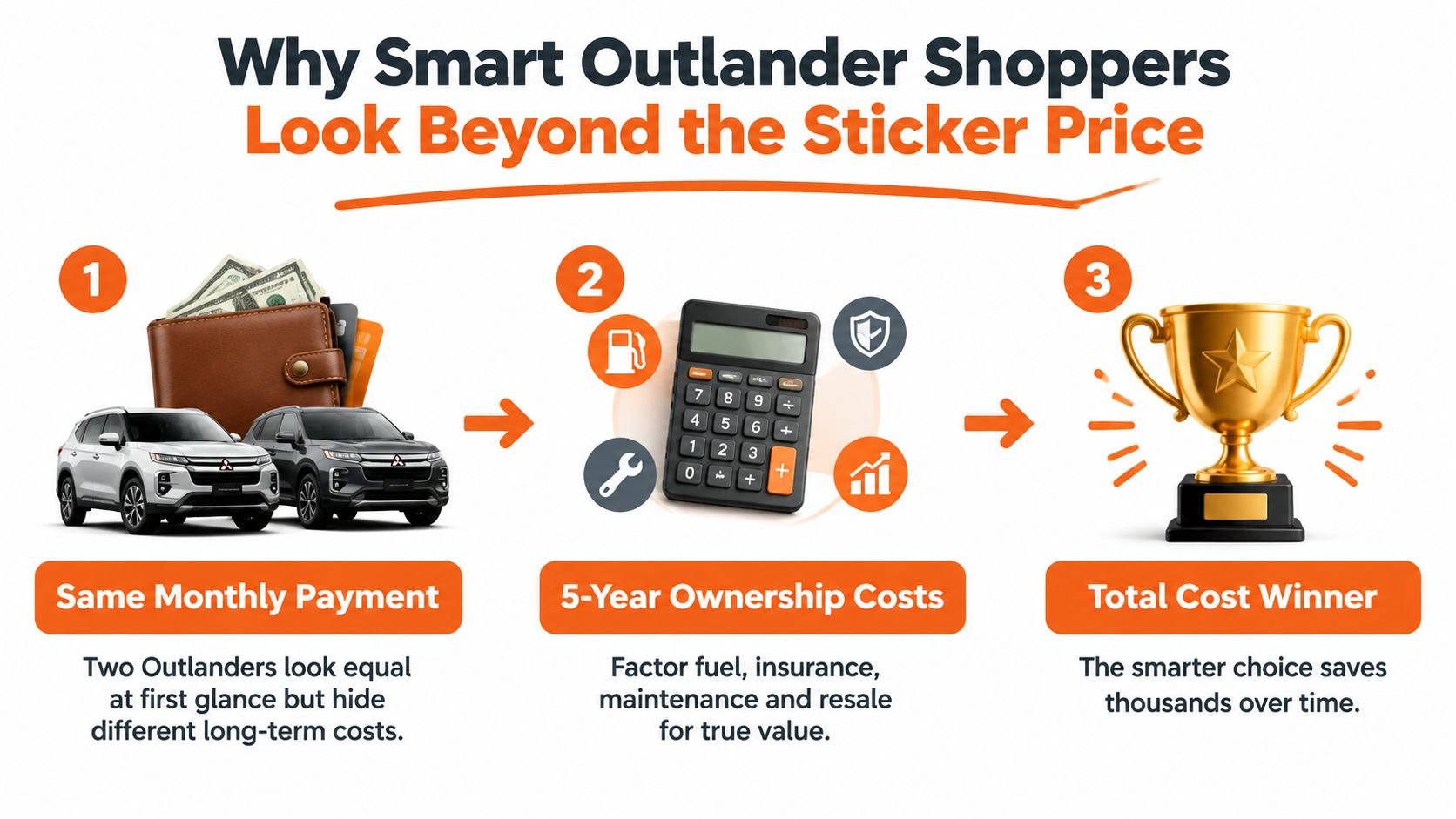
Table of Contents
- Why Smart Outlander Shoppers Look Beyond the Sticker Price
- Understanding the Outlander Lineup and Where the PHEV Fits
- Finding the Right Outlander Using Filters and Vehicle Finder
- Comparing New, Certified Pre-Owned, and Used Under $20,000
- When the Outlander PHEV Actually Pays for Itself
- Financing, Leasing, and Trade-In Options That Lower the Real Number
- Ownership Risk, Recalls, and Why Certified Service Matters
- Your Next Steps From Freeport to Your Driveway
Why Smart Outlander Shoppers Look Beyond the Sticker Price
A lot of buyers get trapped by a simple comparison. Two Outlanders can land near the same payment, but one of them can bleed more value over time, cost more in fuel, and expose you to more ownership risk. If you only care about the lowest number on the windshield, stop there. If you care about what the SUV costs you after a few years of real driving, keep going.
The number that matters is not the sticker
Depreciation is the first thing most shoppers ignore, and it’s the biggest reason a low price can still be a bad deal. Independent pricing data says the 2026 Outlander carries retained value of 7.4/10, estimated depreciation of about 49.1%, and a 14.2% probability of reaching 200,000 miles according to iSeeCars’ Outlander page. That doesn’t mean the SUV is a mistake. It means you need to buy it with your eyes open and plan around the long game.
The second lever is fuel type. A higher-trim gas Outlander can make more sense than a stripped version if you’re comparing true ownership cost, not just the monthly note. The 2025 to 2026 Outlander’s turbocharged 1.5L inline-4 returns 174 hp and 26 mpg city in the cited spec listing, which points to an efficiency-first setup rather than a performance-first one from Car and Driver’s listing. That kind of tuning matters if your commute is heavy on stop-and-go traffic.
Practical rule: Buy the trim you can keep comfortably, not the cheapest trim you can barely justify.
Warranty coverage also changes the math. Mitsubishi’s long powertrain protection helps reduce fear around major repairs, but you still need a dealer service plan and a realistic maintenance routine to keep ownership predictable. That’s why certified service, roadside support, and a known parts pipeline matter just as much as the badge on the hatch.
Understanding the Outlander Lineup and Where the PHEV Fits
The Outlander family splits into two different shopping decisions. One is the standard three-row SUV. The other is the plug-in hybrid, which behaves differently in daily use and should be judged by charging habits, commute length, and incentive eligibility rather than eco branding alone.
Gas Outlander versus Outlander PHEV
The regular Outlander is the one most families cross-shop first because it brings 7-passenger seating and standard AWD in the cited review, making it a strong fit for daily school runs, carpools, and occasional third-row use Car and Driver’s Outlander listing. Mitsubishi’s broader U.S. sales story also shows the nameplate staying relevant as electrification grew, since 2020 U.S. sales included 1,964 Outlander PHEV units within 29,096 total Outlander sales, while 2025 U.S. sales included 6,294 PHEV units within 42,189 total Outlander sales from Automotive World. That tells you the PHEV is no niche experiment, it’s a meaningful slice of the lineup.
The PHEV is a different animal because it can handle many short trips on electricity and then switch to gasoline for longer drives. Current-market reporting cites a 22.7 kWh battery, about 45 miles of electric-only range, roughly 6.5 hours on a 240V Level 2 charge, and about 29 minutes to reach 80% on CHAdeMO DC fast charging. That makes it useful for commuters, but only if you plug it in.
Trim selection should match use case
The gas Outlander makes sense if you want simple ownership, three-row utility, and a lower upfront price. The PHEV makes sense if you can charge routinely and want to use electric driving for part of the week. If you never plug in, you’re buying the wrong version.
| Outlander Trim Snapshot at a Glance | Drivetrain | Seating | Standout Feature |
|---|---|---|---|
| ES | Gas or plug-in hybrid depending on model family | 7 passengers on the gas SUV | Entry point for shoppers who want the Outlander shape without chasing extras |
| SE | Gas or plug-in hybrid depending on model family | 7 passengers on the gas SUV | A sensible middle ground for most first-time buyers |
| SE Black Edition | Gas SUV | 7 passengers | Appearance upgrades with a darker, more aggressive look |
| SEL | Gas or plug-in hybrid depending on model family | 7 passengers on the gas SUV | Better equipment balance for families who plan to keep the vehicle |
| SEL Premium | Gas SUV | 7 passengers | More comfort and convenience gear for longer ownership |
| RALLIART-style trims | Gas or plug-in hybrid depending on model family | 7 passengers on the gas SUV | The visual punch for buyers who want a sportier feel |
Finding the Right Outlander Using Filters and Vehicle Finder
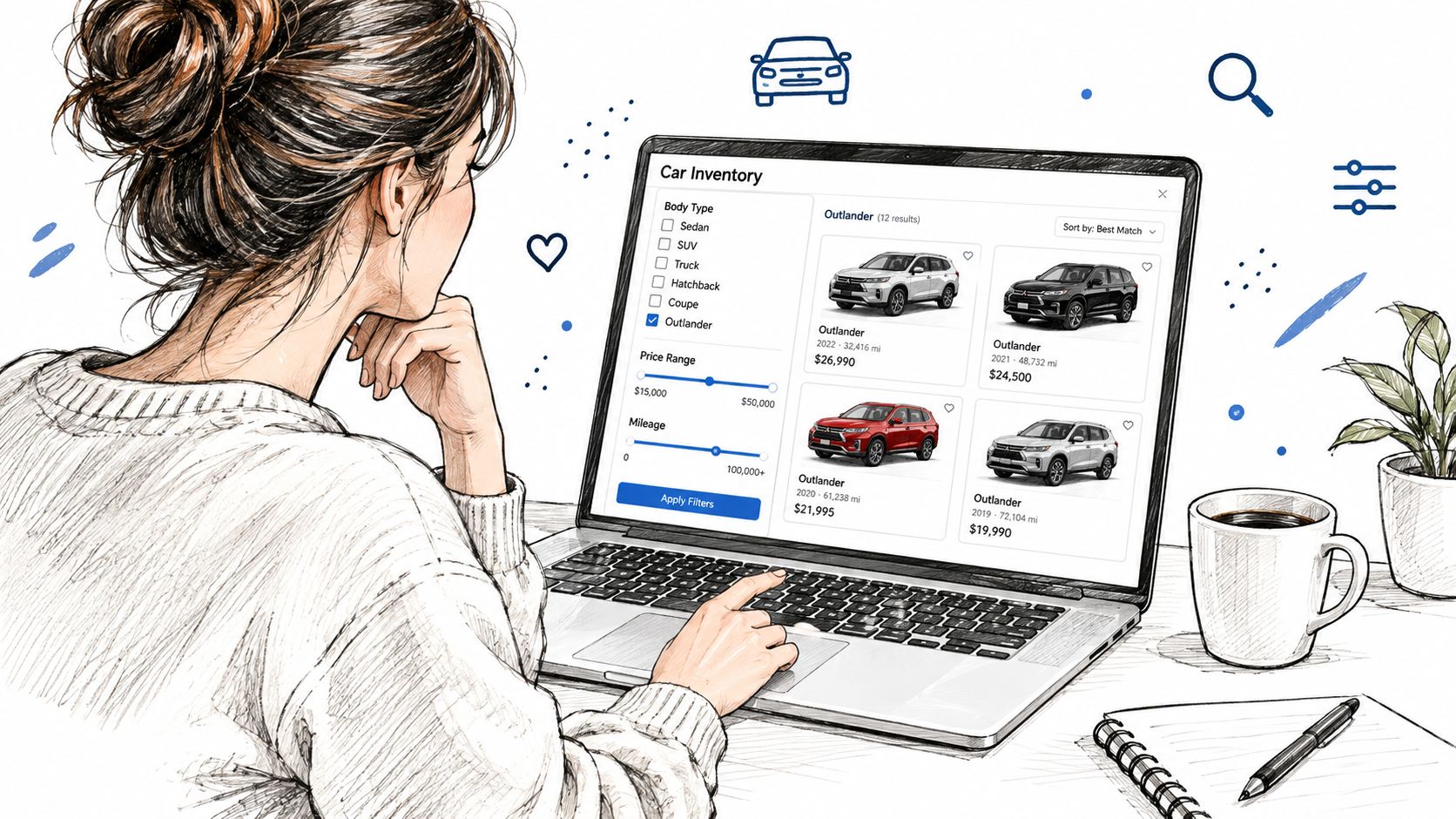
The fastest way to waste time is to show up without narrowing the stock online first. If you search mitsubishi outlander for sale and start from a blank screen, you’ll end up comparing vehicles that don’t fit your budget, your commute, or your seat needs. Use the inventory tools first, then call with a short list.
Start with the filters that actually matter
Begin by separating Outlander SUV from Outlander PHEV. That one choice cuts the field in half because the ownership math is different for each. Then layer on model year, price ceiling, mileage, drivetrain, and color so you’re looking at a realistic set of candidates instead of every Outlander on the lot.
The keyword field is useful when you want a specific package. Search terms like Black Edition, SEL Premium, or RALLIART to surface trims with the look or equipment you want. Saved searches are even better because they send alerts when matching stock arrives, including incoming units that haven’t been photographed yet.
Good showroom habit: Screenshot the filtered results before you call. It keeps the conversation focused on actual stock numbers instead of vague descriptions.
The trade-in tool matters just as much. Enter your VIN or license plate, get an estimate, and use that number as your down payment baseline before you even start negotiating. That way you know whether your trade is helping or just making the payment look smaller than it really is.
South Shore Mitsubishi also offers a Vehicle Finder request form, which is useful if inventory is thin or you need a specific trim and payment target. You submit the must-haves, and a dealership advisor reaches out when a match shows up. That’s a better use of your time than refreshing listings all week.
Comparing New, Certified Pre-Owned, and Used Under $20,000
Price tags don’t tell the whole story. A new Outlander, a Certified Pre-Owned model, and a used one under $20,000 solve different problems, and if you choose the wrong category you’ll feel it later in repairs, resale, or payment pressure. The right pick depends on how long you plan to keep it and how much risk you can stomach.
New gives you certainty, but you pay for it
A new Outlander gives you the cleanest starting point, the freshest warranty situation, and the most predictable condition. It also exposes you to early depreciation, which is why the first buyer carries the biggest hit. That’s the tradeoff, and you should accept it only if you plan to keep the SUV for years, not months.
Certified Pre-Owned is the balanced play. It gives you a structured inspection process, warranty protection, and usually a lower entry price than new. Used under $20,000 is the budget-first option, but you need to assume some wear and possibly immediate maintenance like tires or brakes.
| New vs. CPO vs. Used Under $20K Outlander | New Outlander | Certified Pre-Owned | Used Under $20K |
|---|---|---|---|
| Warranty feel | Full new-vehicle coverage and powertrain protection | Extended confidence with inspection-backed coverage | Coverage depends on model year and remaining factory terms |
| Upfront cost | Highest | Lower than new | Lowest |
| Depreciation exposure | Highest early on | Moderate | Lower as a purchase price, but still tied to age and mileage |
| Reconditioning | None needed, because it’s new | Inspected and reconditioned | Condition varies widely |
| Best for | Long-term owners | Buyers who want a middle path | Shoppers with tight monthly budgets |
If you want the simplest answer, here it is. Buy new if you’ll keep it a long time. Buy CPO if you want less risk without paying new-car money. Buy used under $20,000 only if the payment matters more than long-term refinement.
When the Outlander PHEV Actually Pays for Itself
The Outlander PHEV should not be bought because it sounds responsible. It should be bought because the numbers make sense for your commute, your charging habits, and your rebate eligibility. If those three pieces don’t line up, the gasoline Outlander is the better deal.
Incentives and driving routine decide the value
Recent coverage says the 2026 Outlander PHEV has about 45 miles of electric range, which is enough to cover a lot of daily local driving before the engine wakes up. That matters most for commuters with short round trips and regular access to charging at home or work. The practical value drops fast if you can’t plug in consistently.
Federal and local incentive rules also change the math, and trim choice matters. Recent coverage notes that some trims can qualify while others may fall near program thresholds, and that makes transaction price highly variable as reported by Cars.com. Buyers often miss this and assume every PHEV purchase gets the same deal, which is not true.
Simple test: If you qualify for incentives, charge often, and drive mostly local miles, the PHEV starts to make sense. If not, don’t force it.
The gas-versus-PHEV decision becomes easier once you stop thinking in terms of labels and start thinking in ownership habits. The plug-in is worth it for the right driver, not every driver.
Financing, Leasing, and Trade-In Options That Lower the Real Number
The out-the-door number usually drops only when you use all three levers together. Financing, leasing, and trade-in value each change the math in a different way, and the buyer who ignores one of them is usually the one overpaying. Don’t negotiate from the sticker. Negotiate from the complete transaction.
Financing works when you plan to keep the SUV
Financing through Mitsubishi Motors Credit can run from 24 to 84 months, with the rate tied to credit tier. Pre-qualifying through the Capital One auto finance path on the dealer site gives you a real starting point without a hard credit hit, so you know what you can afford before the first salesman pencil comes out.
Leasing is different. It usually lowers the monthly payment, but it comes with mileage caps and excess-mile charges, so it only makes sense if you drive predictably and don’t rack up long annual commutes. If your life is messy, a lease can get expensive fast.
Trade-in value should be used before you enter the showroom
Your current vehicle can do a lot of work for you if you price it correctly. The online appraisal tool sets a baseline before the negotiation starts, and clean-history vehicles often hold stronger value than tired trade-ins with unresolved issues. That number should be on paper before you talk about payment.
- Get pre-qualified first: It tells you what kind of loan terms are realistic before you shop trims.
- Appraise the trade early: It keeps the discussion tied to equity, not just monthly payment.
- Compare lease and finance side by side: One is about flexibility, the other is about long-term ownership.
If you want the cleanest first move, complete the pre-qualification, run the trade-in appraisal, and then compare actual numbers with the vehicle you want. That’s how you shop like an adult instead of letting the first payment quote set the whole deal.
Ownership Risk, Recalls, and Why Certified Service Matters
A first-year owner usually learns the hard way that cheap payments don’t protect you from downtime. One commuter can sign for an Outlander on a spring promotion, feel great for a month, then get hit by a service light, a recall notice, or a warranty question that turns into a half-day interruption. That’s where certified service stops being a talking point and starts being a cost-control tool.
Why recall and service history matter
Recall completion records affect confidence at resale, and they matter before purchase too. Consumer-facing recall coverage shows that 2022 to 2024 Outlander and 2023 to 2025 Outlander PHEV models were recalled for a backup-camera display failure as covered by iSeeCars. If you’re shopping used, verify the VIN history before you sign anything.
An independent shop can absolutely handle basic work, but a Mitsubishi-certified service center has the tools, software access, and OEM part flow that a generic repair shop may not. That difference matters when the issue is tied to factory electronics, calibration, or a warranty claim. It’s not about prestige, it’s about getting the job done correctly the first time.
Real-world advice: Keep your service records clean, keep up with routine maintenance, and don’t assume a low-mileage SUV is automatically a low-risk SUV.
Factory-certified technicians, OEM fluids, and brand-specific diagnostics are the practical advantages that keep ownership manageable. They also make it easier to explain the car’s condition later when it’s time to trade or sell. That protects value in a way a low sticker price never will.
Your Next Steps From Freeport to Your Driveway
You can get most of this done in one afternoon if you stay organized. Start online, narrow the choices, and then use the showroom visit to confirm fit instead of starting from scratch. That keeps your energy on the right decisions, not on scrolling.
A simple buying sequence
- Filter inventory online. Sort by trim, price, mileage, and whether you want a gas Outlander or a PHEV. Save three candidates so you’ve got a fallback if one unit sells.
- Value your trade. Use the appraisal tool before you leave home so you know your equity position.
- Secure financing early. Pre-qualification gives you an advantage and prevents payment shocks.
- Test drive back to back. Compare the vehicle you think you want against the one you can live with.
For in-person shopping, South Shore Mitsubishi has a showroom at 185 Sunrise Hwy, Freeport, NY 11520 and a service address at 126 E Merrick Rd, Freeport, NY 11520. Its site also supports online browsing, trade-in appraisal, financing guidance, and vehicle-finder requests, which makes it easy to do the prep work before you ever step inside. If you’re booking a visit, line up your driver’s license, insurance card, and proof of income so the numbers can be finalized without delay.
The best move is simple. Pick a Saturday, book two test drives, and arrive with your trade-in details and financing plan already in hand.
If you’re ready to compare real Outlander stock, payment paths, and PHEV options in one visit, check current inventory and schedule your drive at South Shore Mitsubishi. Bring your trade, your license, and your income documents, and you can leave with a much clearer answer than a sticker-price search will ever give you.
0 comment(s) so far on Mitsubishi Outlander for Sale: A Local Buyer’s Guide