
Mitsubishi Outlander Hybrid MPG Explained and Compared
The 2025 Outlander PHEV is 26 mpg combined on gas alone and 64 MPGe combined with 38 miles of EV range. The 2026 model rises to 27 mpg gas-only and 73 MPGe combined with 45 miles of EV range.
You’re probably asking because you want a straight answer before you start comparing trims, driving habits, or monthly fuel stops. That’s the right instinct with a plug-in hybrid, because one number doesn’t tell the whole story.
If you live on Long Island, a daily drive can be short, stop-and-go, and easy to recharge at home, or it can stretch into a longer highway run where the battery is gone before you reach your destination. In the first case, the Outlander PHEV can act like an electric SUV with gasoline backup. In the second, it starts to feel much closer to a conventional hybrid.
That’s why mitsubishi outlander hybrid mpg gets confusing fast. The same vehicle can look like a 26 mpg SUV in one scenario and a 64 MPGe or 73 MPGe SUV in another, depending on whether you plug in and how far you drive. This guide breaks that down in plain English, so you can tell whether the Outlander PHEV fits your commute, your charging routine, and your road-trip habits.
Table of Contents
- Introduction to Mitsubishi Outlander Hybrid MPG
- Understanding MPG and MPGe in Hybrid SUVs
- Official Mitsubishi Outlander Hybrid MPG and MPGe Ratings
- How Outlander PHEV Compares to Gas Outlander Models
- Why Battery Size and Charging Habits Change Real MPG
- Practical Tips to Maximize Your Outlander Hybrid Fuel Economy
- Choosing the Right Outlander for Your Driving Needs
Introduction to Mitsubishi Outlander Hybrid MPG
A lot of shoppers ask the mpg question after they’ve already imagined the drive. They’re thinking about school drop-offs, errands in Nassau County, or a weekday commute that starts before sunrise and ends after dinner. In that real-world setting, a plug-in hybrid’s fuel economy depends less on the brochure and more on whether the battery is charged when you leave.
That’s the key reason the Outlander PHEV deserves a different conversation than a regular gas SUV. The gas-only figure tells you what happens after the battery is drained, while the MPGe figure reflects what happens when electricity is part of the drive. Those are different use cases, not competing slogans.
A Long Island example makes the split easier to see. If your round trip stays within electric range and you charge at home, you may spend most of the week using electricity first and gasoline second. If you skip charging or spend most of your time on longer highway trips, you’ll rely more on the gas-side efficiency.
The Outlander lineup includes both conventional gas models and the Outlander PHEV, so shoppers can’t compare them with one blanket mpg number. The plug-in version is built to reward charging habits, while the gas version is judged the old-fashioned way, by gasoline economy alone. That distinction matters before you start comparing trims, leases, or ownership costs.
By the end, you’ll know how to read mpg, MPGe, and EV range as a single decision tool, not three confusing labels. You’ll also be able to judge whether the Outlander PHEV makes sense for your daily pattern, or whether a gas Outlander is the simpler fit.
Understanding MPG and MPGe in Hybrid SUVs
MPG measures how far a vehicle travels on one gallon of gasoline. MPGe measures how far a plug-in hybrid can go using the energy in its battery plus gasoline, translated into a familiar fuel-equivalent number. That’s why a plug-in hybrid can show two different results and still be telling the truth in both cases.
Think of the Outlander PHEV as having two energy stores. One is the battery, which handles electric miles when it’s charged. The other is the fuel tank, which takes over after the battery is depleted or when the system decides gasoline is the better source of power.
Practical rule: if you plug in often, MPGe matters more. If you rarely charge, gas-only mpg becomes the figure that shapes your driving costs.
The easiest mistake is assuming MPGe is just a fancier version of mpg. It isn’t. A higher MPGe doesn’t mean the SUV magically gets better on a long empty-battery highway trip. It means the vehicle used electricity efficiently during a period when electric power was part of the drive.
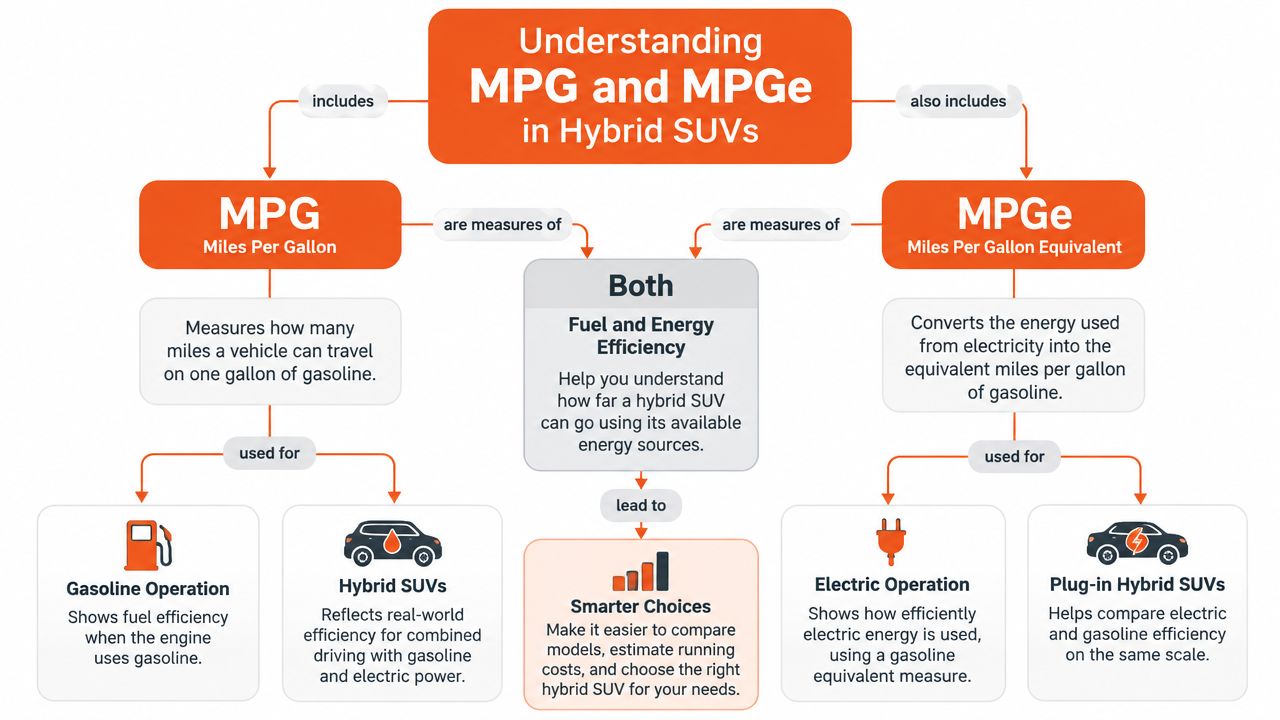
For plug-in hybrid shoppers, the question is not whether the MPGe number looks impressive. The question is whether your routine keeps the battery in play often enough for that number to matter. Short trips, regular charging, and an EV-friendly commute tilt the result toward MPGe. Long, uncharged highway drives push you back toward mpg.
That’s why battery range is so important. Once electric miles are used up, the vehicle doesn’t vanish into a different category, it behaves more like a hybrid SUV running primarily on gasoline. The better you understand that split, the easier it is to predict what your own ownership experience will look like.
Official Mitsubishi Outlander Hybrid MPG and MPGe Ratings
The official numbers show exactly how the Outlander PHEV changes character depending on driving mode. For the 2025 Mitsubishi Outlander PHEV, the EPA rating is 25 mpg city, 27 mpg highway, and 26 mpg combined on gasoline alone, with 64 MPGe combined, 38 miles of all-electric range, and 420 miles of combined range according to the data summarized by Cars.com and Edmunds. Mitsubishi’s own product information for the 2026 model lists the plug-in side at 73 MPGe combined with up to 45 miles of electric range.
Here’s the simplest way to read that. The gas-only number tells you what the SUV does after the battery has been used up. The MPGe number tells you what it can do when the electric system is actively helping, which is why the same vehicle can look modest in one mode and much stronger in the other.
| Model Year | Gas-Only MPG Combined | MPGe Combined | EV Range | Battery |
|---|---|---|---|---|
| 2025 | 26 mpg combined | 64 MPGe combined | 38 miles | Not listed in the 2025 summary source |
| 2026 | 27 mpg combined, 27 mpg drained-battery combined | 73 MPGe combined | 45 miles | 22.7 kWh |
The jump from 64 MPGe to 73 MPGe is tied to a larger 22.7 kWh battery and more EV range for 2026, which means more of your everyday driving can happen before gasoline matters. That doesn’t turn the Outlander PHEV into a pure EV, but it does widen the window where charging pays off.
Mitsubishi’s position as the maker of the world’s first plug-in hybrid SUV, launched in 2013, adds context to those figures. Mitsubishi said the model reached 200,000 global sales by April 11, 2019, and the company also cited low fuel-consumption results in global test cycles for the 2019 version, including 1.8 l/100km under NEDC Correlated testing and 2.0 l/100km under WLTP. That history helps explain why the Outlander PHEV keeps showing up in efficiency conversations.
How Outlander PHEV Compares to Gas Outlander Models
Once the battery is depleted, the Outlander PHEV behaves much more like a conventional hybrid SUV than a plug-in showcase piece. That’s why the gas-side number is so important. Independent testing backs that up, since Car and Driver recorded 25 mpg on its 75-mph highway route when running on gas only, and Consumer Reports also found 25 mpg in hybrid operation.
That’s close to the EPA-style 27 mpg combined figure for the gas-drained vehicle, which tells you something useful. The brochure number isn’t fantasy, but it also isn’t a promise that every drive will feel electrified. On long highway stretches, the plug-in advantage fades quickly if the battery isn’t charged.
Why the gap feels bigger in daily use
The reason shoppers get tripped up is that their daily life is usually mixed. A school run, grocery stop, and office commute can make the Outlander PHEV feel extremely efficient because a lot of miles happen inside the battery’s range. Then a weekend drive to a farther destination can pull the average back toward the mid-20s.
That’s also where the car-and-driver test results matter. The same vehicle that posted 25 mpg on gas-only highway driving can still show a much better outcome when a full charge is part of the trip. In that sense, the Outlander PHEV rewards planning, not wishful thinking.
A plug-in hybrid is only as efficient as your charging routine lets it be.
For shoppers comparing it with a regular gas Outlander, the decision often comes down to simple math around habits. If you charge regularly and most of your miles are short, the PHEV’s electrified side can dominate your fuel use. If you drive long distances without plugging in, the value of the plug-in system shrinks and the gas-only figure becomes the one that matters.
Why Battery Size and Charging Habits Change Real MPG
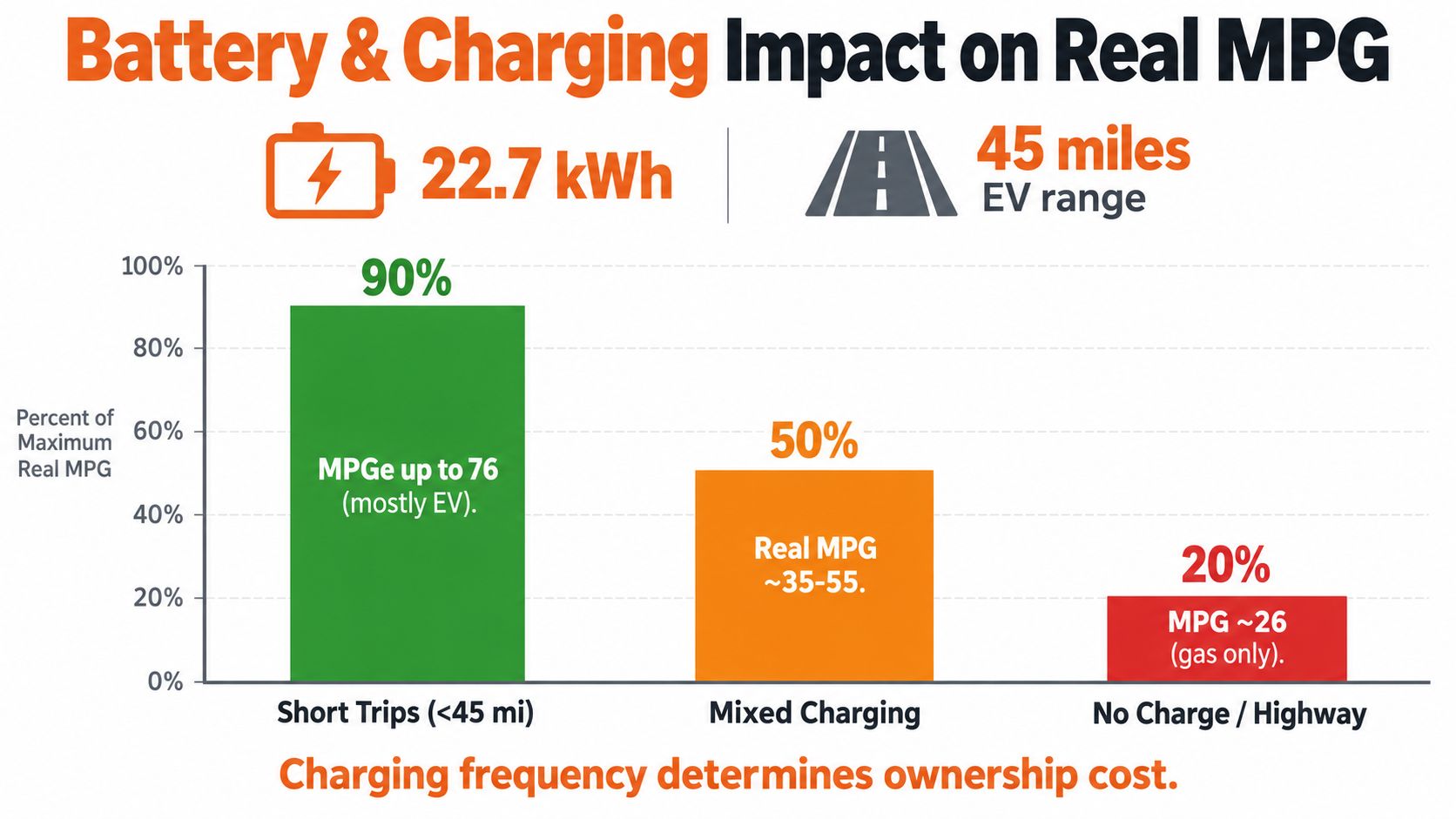
The 2026 Outlander PHEV adds a 22.7 kWh battery and 45 miles of EV range, and that matters more than the spec sheet might suggest. The point isn’t just that the battery got bigger. It’s that more of your normal driving can stay in electric mode before the gasoline engine has to step in.
That’s why a plug-in hybrid can produce radically different ownership experiences for two drivers with the same vehicle. One driver plugs in every night and keeps most local errands inside electric range. Another driver forgets to charge or spends most of the week on longer highway trips. They own the same SUV, but they don’t live with the same fuel economy.
The best evidence of that split is the independent road-test result that recorded 101 mpg over a 70-mile trip with a full charge, alongside 33 mpg in hybrid mode alone. Those numbers don’t contradict each other. They show how strongly charging behavior changes the outcome.
A simple way to judge your own fit
Start with your usual daily driving distance. If your routine is shorter than the EV range and you can charge regularly, the electric side will do most of the work. If your trips often stretch beyond range, gasoline will take over sooner, and the average mpg will move closer to the gas-only number.
That’s why people who ask about mitsubishi outlander hybrid mpg are really asking a charging question. How often will you plug in, and how often will you leave with a full battery? The answer decides whether the SUV behaves like an electric-first commuter or a gas-assisted road traveler.
What changes ownership cost in practice
Charging frequency is the lever that changes the experience. A full battery before short trips can make the Outlander PHEV feel dramatically more efficient than a conventional SUV. Sparse charging does the opposite, because the vehicle spends more time running like a hybrid with the battery support mostly out of the picture.
You don’t need perfect charging habits to see a benefit. You do need consistent ones. If you want the plug-in side to matter, make charging part of the routine rather than a weekend-only habit.
Practical Tips to Maximize Your Outlander Hybrid Fuel Economy
The easiest way to improve results is to treat the Outlander PHEV like a vehicle that wants routine, not rescue. The more often it leaves home with usable battery charge, the less often gasoline has to carry the whole trip. That’s the heart of the efficiency story.
Focus on charging before driving style
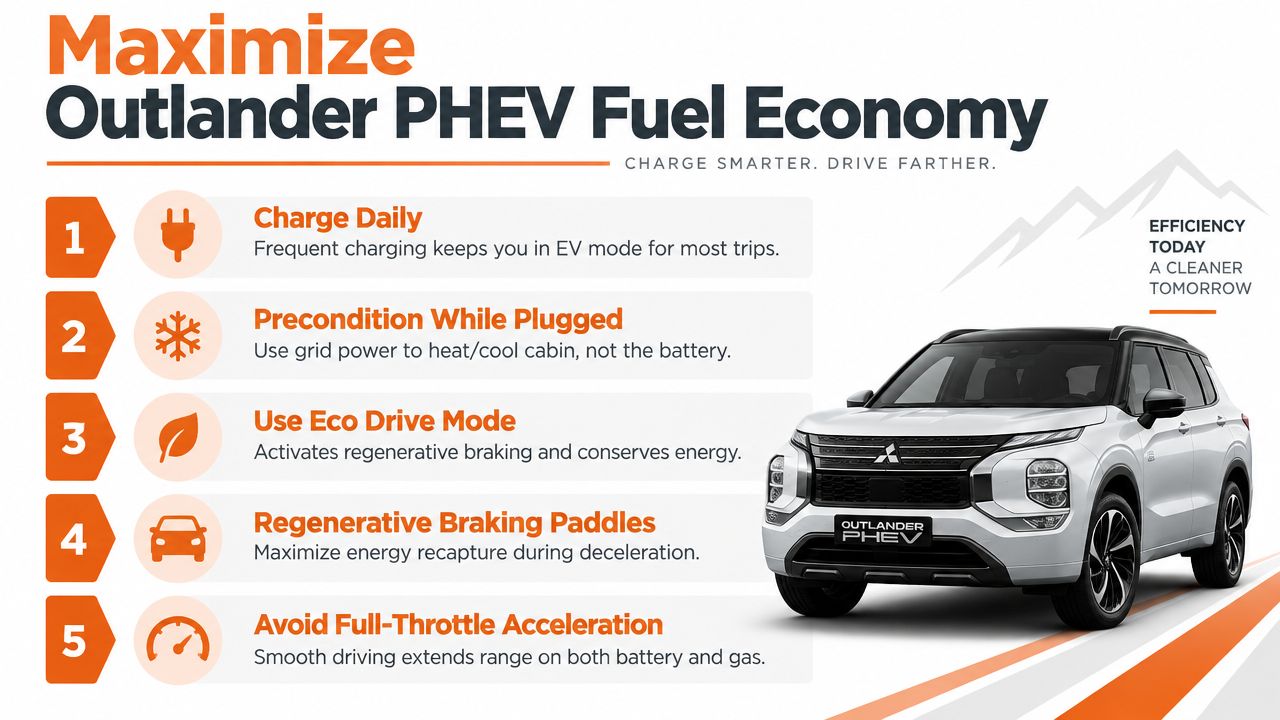
Daily charging does more for mpg than almost any clever driving trick. If you leave with a full battery for short errands, the vehicle can cover those miles electrically instead of burning gasoline. Preconditioning while plugged in helps too, because you’re using outside power to heat or cool the cabin instead of draining the battery immediately.
Use the EV range where it counts
The best time to spend battery power is on trips you can finish within range. That means local commuting, school runs, and neighborhood errands are the sweet spot. Save the battery for the parts of your day that happen closest to home, then let gasoline handle longer stretches.
Charge at home whenever you can, then use the battery for the miles you repeat most often.
Keep the car efficient without making it complicated
Smooth acceleration matters because sudden throttle use burns through electric range faster and can push the SUV into gasoline mode sooner. Tire pressure also matters in the ordinary way it does for any SUV, since underinflated tires create more resistance and make every mile work harder.
Route choice helps too. Stop-and-go traffic isn’t always bad for a plug-in hybrid if you’ve charged it first, because low-speed electric travel can work in your favor. Long high-speed stretches are where the gas side takes over faster, so the trip plan matters as much as the vehicle.
Build a habit, not a workaround
Consistent overnight charging beats occasional charging because it keeps the plug-in system ready for the next day. That’s especially useful if your routine is predictable. You’re not chasing a fuel economy miracle, you’re arranging the car so it uses electricity first whenever that makes sense.
Choosing the Right Outlander for Your Driving Needs
The right version of the Outlander comes down to where your miles happen. If your life is built around short drives, easy home charging, and a desire to use electricity as often as possible, the Outlander PHEV makes a lot of sense. If your schedule is mostly long highway stretches and you don’t plan to plug in often, the gas model may feel simpler.
That decision is easier once you stop treating mpg and MPGe as the same thing. The PHEV’s numbers only look contradictory if you expect one rating to cover every kind of trip. Once you accept that charging behavior shapes the result, the chart becomes much more readable.
The model’s history also matters. Mitsubishi introduced the world’s first plug-in hybrid SUV in 2013, and by April 11, 2019, the nameplate had reached 200,000 global sales according to Mitsubishi Motors. That long track record gives the Outlander PHEV a deeper credibility than many newer plug-in entries.
If you’re comparing trims, financing, or service support locally, South Shore Mitsubishi in Freeport is one place to look at the current Outlander and Outlander PHEV lineup, along with factory-certified service and parts. Use that visit to test your commute logic against the vehicle, not just the spec sheet.
If you’re ready to compare the Outlander and Outlander PHEV side by side, South Shore Mitsubishi can help with inventory, financing, trade-in tools, and certified service in Freeport. Visit South Shore Mitsubishi to see current options and decide whether a plug-in hybrid fits your daily driving pattern.
0 comment(s) so far on Mitsubishi Outlander Hybrid MPG Explained and Compared