
What Documents Are Needed When Buying a Car: NY Checklist
You’ve picked the car, agreed on a price, and you’re picturing the drive home down Sunrise Highway. Then the finance office asks for an insurance binder with the new VIN, a payoff letter for your trade, or income proof you left in a kitchen drawer. The car stays on the lot while you make a second trip.
That’s how most Long Island purchases stall. It’s not the negotiation. It’s one missing paper. Treat what documents are needed when buying a car as a packet you verify before signing, at signing, and after delivery, and you’ll avoid the delays, mismatched numbers, and title headaches that catch buyers who rely on a generic checklist.
Table of Contents
- Documents Required for New, Used and Private-Party Purchases
- How to Gather Your Documents in the Right Order
- New York Title, Registration and Tax Forms Explained
- Trade-Ins, Out-of-State Cars and Plug-In Hybrids
- Common Document Problems and How to Fix Them
- Financing Papers and the Delivery Packet
- Financing Paperwork to Review Before You Sign
Documents Required for New, Used and Private-Party Purchases
The identity and insurance core is the same for every purchase. What changes is the ownership file.
A new car from a dealer relies on the Manufacturer’s Certificate of Origin and the dealer’s certificate of sale. A used car from a dealer relies on the seller’s title and required disclosures. A private-party sale relies entirely on the seller transferring the title correctly, because there’s no dealer to catch a mistake.
The visual below maps those three paths side by side.
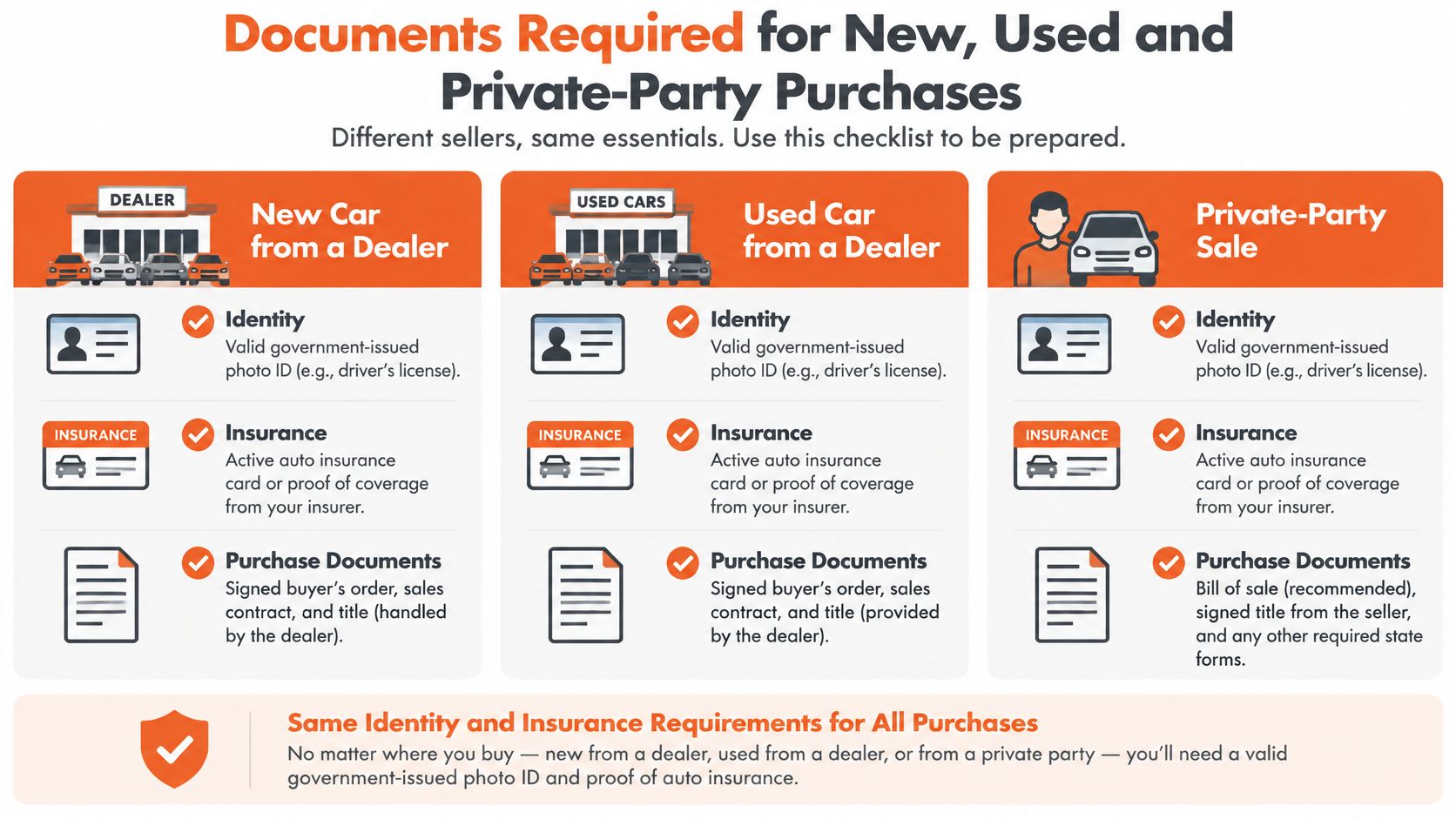
Required Documents by Purchase Path
| Document | New from dealer | Used from dealer | Private party |
|---|---|---|---|
| Valid driver’s license or state ID | Required | Required | Required |
| Proof of auto insurance for the new VIN | Required before pickup | Required before pickup | Required before registration |
| Manufacturer’s Certificate of Origin | Required, supplied by dealer | Not applicable | Not applicable |
| Certificate of title signed over by seller | Not applicable | Required from seller | Required from seller |
| Dealer Certificate of Sale (MV-50) | Required, supplied by dealer | Required, supplied by dealer | Not applicable |
| Odometer disclosure | Included in dealer packet | Required | Required |
| Buyer’s order or bill of sale | Required | Required | Required |
| Financing contract (retail installment contract) | Required if financed | Required if financed | Required if financed |
| Current New York safety inspection certificate | Not applicable | Verify with dealer | Required before registration |
| Sales tax proof (dealer receipt or FS-6T) | Paid at dealer | Paid at dealer | Paid at DMV with registration |
| Trade-in title and lien payoff letter | If trading in | If trading in | Not applicable |
Financing adds the loan contract to every column. A trade-in adds its title and payoff paperwork to the first two.
Find your column before you visit. Treat every required row as something you confirm in hand, or confirm the dealer has, before you sign. Don’t discover a gap after you’ve signed.
How to Gather Your Documents in the Right Order
Most purchase-day delays have one cause. One missing paper forces a second trip. Gather in order, so each step enables the next.
The flow below shows the sequence in plain form.
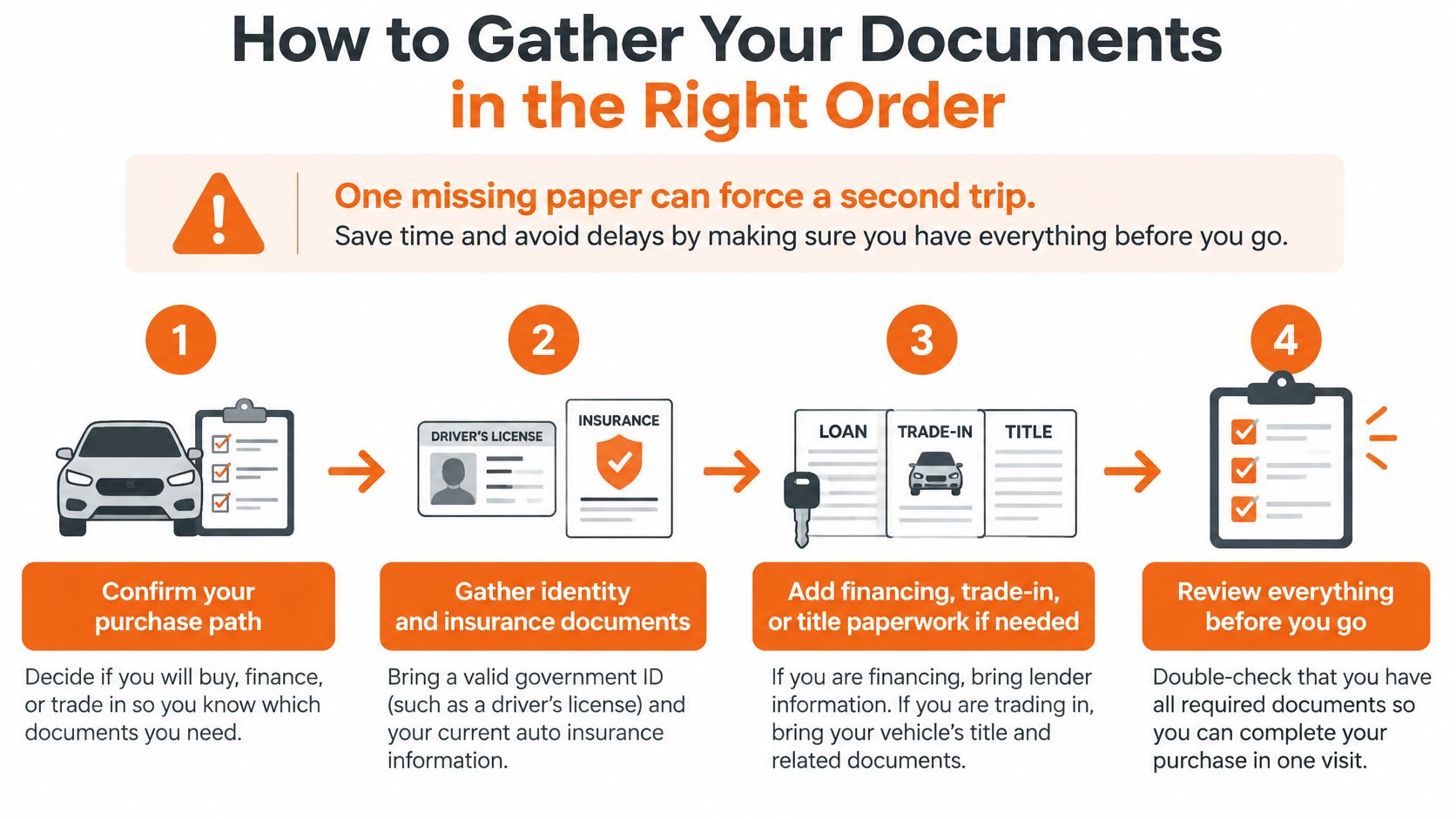
Use this sequence at home, not in the finance office.
- Confirm your path first. Decide whether you’re buying new, used, or private party, and whether you’ll finance or trade in. That answer determines the rest of the list.
- Collect identity. Bring an unexpired driver’s license. Add proof of address if a lender requests it, and check that your name matches across every form.
- Call your insurer early. Ask for a policy or binder listing the new vehicle’s VIN. A binder written for the wrong VIN is a common and avoidable slip.
- Pull trade paperwork. Find the title in your name. If a lender holds a lien, request a current payoff letter now, not at the desk.
- Assemble income proof. If you’ll apply for financing, bring recent pay stubs and two months of bank statements. Self-employed buyers should expect to show more records.
- Ask the seller in advance. Confirm the title, odometer disclosure, and inspection status before purchase day. Private sellers need time to fix problems too.
- Scan and carry originals. Put every document in one phone folder, then bring the originals to pickup.
This short walkthrough reinforces why preparation beats improvising at the dealership.
Run a five-minute check the night before. License, VIN-specific insurance, income papers, trade title, and payoff letter. If one item is missing, make the call that night.
New York Title, Registration and Tax Forms Explained
New York treats title and registration as separate jobs. The New York DMV registration and title guide explains that the title certificate proves ownership, while registration authorizes operation on public roads.
That’s why a bill of sale alone isn’t enough. You need ownership papers and registration materials together.
For a new vehicle from a New York-registered dealer, the ownership file generally includes the Manufacturer’s Certificate of Origin (MCO) and the dealer’s Certificate of Sale, form MV-50, according to that same guidance. For a used vehicle, it lists the previous owner’s Certificate of Title, form MV-999, correct odometer and damage disclosures, and the dealer’s MV-50.
New York Title and Registration Forms
| Form | Who supplies it | What it proves | When you need it |
|---|---|---|---|
| Manufacturer’s Certificate of Origin (MCO) | Manufacturer, through the dealer | Original ownership of a new vehicle | New car from a NY-registered dealer |
| Dealer Certificate of Sale (MV-50) | Dealer | Sale to the buyer and sales tax handling | New and used dealer purchases |
| Certificate of Title (MV-999) | Previous owner | Ownership transfer from the seller | Used car purchases |
| Vehicle Registration/Title Application (MV-82) | Buyer submits | Application to title and register the vehicle | Private-party sales and title-only transactions |
| Sales tax receipt (FS-6T) | Dealer or DMV record | Sales tax was paid | Title-only transactions without an MV-50 |
In a private-party purchase, the seller must transfer the Certificate of Title, while vehicles from model year 1972 or earlier may use a transferable registration instead. The buyer then submits the MV-82 with proof of identity, date of birth, insurance, and payment of state and county sales taxes.
If you’re buying in Nassau County or elsewhere in the New York City metropolitan area, ask the dealer to confirm the MCO, MV-50, title, and disclosure forms before you leave. Don’t assume the packet is complete because the car is ready.
Trade-Ins, Out-of-State Cars and Plug-In Hybrids
Buyers plan for the car they’re buying. They forget the paperwork created by the car they’re trading, the state they’re buying from, or the powertrain they’ve chosen.
Trade-Ins and Out-of-State Titles
A trade needs the title in your name. If a lender holds a lien, you also need a payoff letter and, once paid, a lien release confirming the debt is cleared.
The payoff amount changes the math of the whole deal. Ask the dealer to show it in writing and confirm who is responsible for paying it, and by when. A verbal estimate isn’t protection later.
The checklist below covers the trade packet dealers ask for most often.
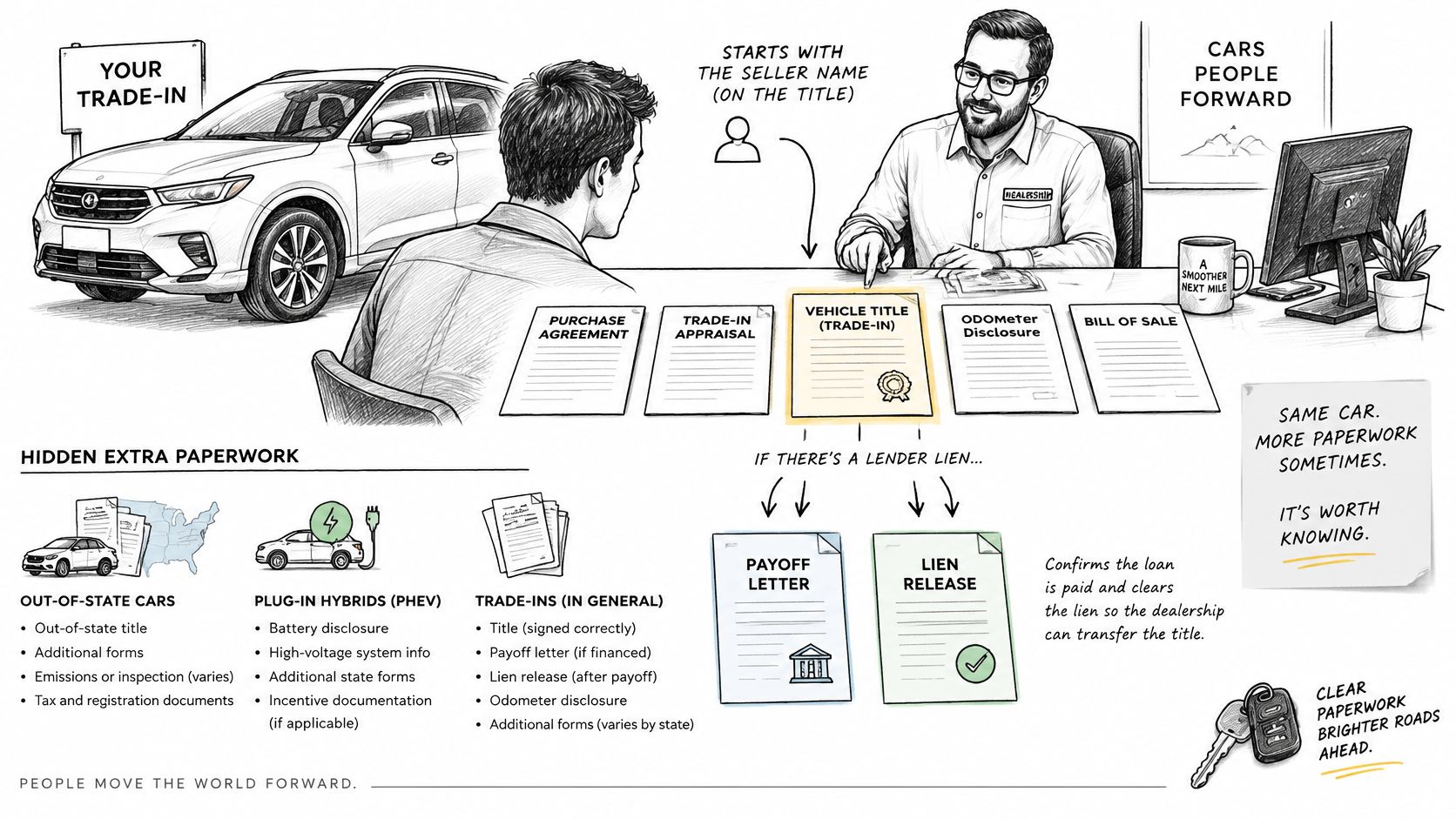
For an out-of-state vehicle, secure the existing title and any lien release before money changes hands. You’ll still need to title and register it in New York, so a missing release from another state’s lender can strand the process.
Plug-In Hybrid Tax Records
Plug-in shoppers, including Outlander PHEV buyers, have extra tax records to keep. The IRS clean vehicle credit guidance says sellers must provide a time-of-sale report when an eligible vehicle is delivered, confirming the VIN, eligibility, credit amount, and whether the credit was transferred to the dealer.
Timing matters now. That guidance states federal clean-vehicle credits are no longer available for vehicles acquired after September 30, 2025.
If a credit was transferred at purchase, you must still reconcile it on your federal return using Form 8936 and Schedule A, reporting the transferred amount. An advertised point-of-sale reduction isn’t a guaranteed tax benefit. Eligibility depends on the buyer, the vehicle, and the transaction.
Keep the accepted IRS report with your contract and VIN paperwork. Treat state or utility programs as separate, with their own records.
Common Document Problems and How to Fix Them
A delayed title is the most expensive document problem because it can leave you paying for a car you can’t cleanly prove is yours. Ask the dealer for the temporary registration or plate arrangement in writing, plus a delivery timeline with a specific date. Then follow up on that date.
Other problems are smaller, but they still stop delivery if you catch them late.
Fixes That Work on the Day
- Lien still showing after payoff. Request the lender’s lien release directly and check the title record. Don’t accept a paid receipt as a substitute for the release.
- Missing MCO on a new car. Ask the dealer to confirm the MCO before you sign. The new-car ownership file depends on it.
- Insurance not ready at pickup. Call your agent for a binder with the correct VIN before you travel to the dealer. Don’t try to fix a wrong VIN from the parking lot.
- Odometer mismatch on a used car. Stop. Ask for a corrected disclosure that matches the car and the title before you sign anything.
- Lost or expired license. Call ahead and ask whether the dealer accepts a temporary license or a secondary identity document for your transaction.
Practical rule: Photograph every signed page before you leave, keep one digital folder per vehicle, and write down the name of the person who promised each missing document.
That note matters two weeks later. A promise without a name and a date is hard to enforce, and you’ll waste time restarting the conversation with someone new.
Financing Papers and the Delivery Packet
Bringing the right papers gets you to signing. Keeping the right papers protects you afterward. Those are different jobs, and buyers often confuse them.
Before you sign, match the deal. Compare the lender name, APR, term in months, monthly payment, amount financed, and every fee against what you negotiated and any pre-qualification you received.
If a figure changed, ask for the reason in writing. Don’t sign until the numbers match or you accept the change knowingly.
What Financed Buyers Should Bring
The New York DMV certificate of title page states an original title application requires proof of ownership, proof that sales tax was paid, and proof of identity, and lists the title-certificate fee as $50.00. For title-only transactions, it lists the MV-82 or title-only application, proof of ownership including any lien release, and either the dealer’s Retail Certificate of Sale, MV-50, or a sales-tax receipt, FS-6T.
That page also supports preparing identification, proof of residence when requested, employment or income information, insurance details, and trade-in title and lien information. A financed vehicle creates a lien, so the lender’s information must be recorded accurately in the contract and title records.
Bring recent pay stubs and two months of bank statements if you’re applying for credit. If your credit is limited or rebuilding, bring proof of down payment, expect to show more income records, and ask in writing what the rate would be without a co-signer.
What You Must Leave With
The FTC guidance on financing or leasing a car advises buyers not to leave without a signed copy of the completed credit contract or lease agreement and notes a lender’s lien can remain on the title until the loan is paid in full.
Build your delivery packet around that advice.
- Signed retail installment contract or lease. This is your evidence of APR, payment, fees, and, for leases, mileage allowance.
- Buyer’s order. It should match the contract line by line.
- Odometer disclosure. Confirm it matches the vehicle.
- Temporary registration. Keep it in the car until permanent documents arrive.
- Title or lien paperwork. Ask who holds the title and when you’ll receive it or confirmation.
- Warranty documents. File them with the contract, not in a glovebox pile.
- Trade-in payoff confirmation. Keep proof of who pays the old lender and how much.
Store everything in one digital folder with your insurance card, tax receipts, and title and lien records. That folder is your evidence if financing terms, a payoff amount, or registration status later differ from what you were told.
Do one thing this week. Before pickup, ask the dealer’s finance team to confirm your complete packet in writing and set a date to check title status.
Financing Paperwork to Review Before You Sign
Financing adds a second layer of documents on top of the purchase file. Read that layer as numbers first, signatures second.
The retail installment contract is the loan agreement. It controls what you’ll pay. The buyer’s order shows the deal you negotiated. If those two documents disagree, the contract is the problem you need fixed before signing.
Match These Numbers First
Start with the lender’s name. Confirm it’s the lender you expected and that its information is spelled correctly for lien and title records.
Then check the APR. Compare it with your pre-qualification or negotiated rate. A higher APR changes the total cost even if the monthly payment looks familiar because the term was stretched.
Check the term in months next. A longer term can hide a higher amount financed. Read it alongside the payment, not instead of it.
Confirm the monthly payment by recalculating it from the APR, term, and amount financed. If you can’t make the math work, ask for an itemized breakdown and wait for a clear answer.
Review the amount financed against the vehicle price, taxes, agreed fees, down payment, trade credit, and trade payoff. Every dollar in that figure should be traceable to a line you agreed to.
Finally, read every fee. Remove anything you didn’t agree to, including add-on products you didn’t request. For a lease, confirm the mileage allowance matches your quote before you sign.
Numbers to Match Before Signing
| Item | Check against | Action if mismatch |
|---|---|---|
| APR | Pre-qualification or negotiated rate | Ask in writing why it changed |
| Term in months | Negotiated term | Do not sign until it matches |
| Monthly payment | Payment quoted at the desk | Recalculate with APR and term |
| Amount financed | Price, down payment and trade-in payoff | Ask for an itemized breakdown |
| Fees | Quoted fee list | Remove any fee not agreed |
| Mileage allowance (leases) | Lease quote | Confirm before signing |
Income, Identity and Pre-Qualification
Lenders typically request identification, residence information, and income documentation to verify an application. Bring recent pay stubs and bank statements rather than waiting for a follow-up request. If you’re self-employed, be ready to provide broader income records.
South Shore Mitsubishi offers an online credit application and a Capital One pre-qualification pathway it describes as having no impact on credit score. Used properly, that kind of pre-qualification lets you see likely terms before you visit and gives you a written benchmark.
Don’t treat that benchmark as the final contract. Compare the pre-qualified APR, term, payment, and amount financed with the signed paperwork. If the final contract is worse, ask why in writing before you proceed.
A pre-qualification is only useful if you bring it to the signing table and compare it, line by line, with the contract in front of you.
Buyers with limited or rebuilding credit should prepare more, not less. Bring proof of down payment, bring complete income records, and ask for terms with and without a co-signer in writing. That comparison shows you what the co-signer is buying you.
Also ask whether a larger down payment changes the APR or only lowers the payment. Those aren’t the same outcome, and the contract should make the answer clear.
Before you sign, run this final check in order.
- Lender and APR. Both match your written quote or you have a written explanation.
- Term and payment. The months and monthly amount match, and the math reconciles.
- Amount financed. Price, taxes, fees, down payment, trade credit, and payoff all add up.
- Fees and add-ons. Nothing appears that you didn’t agree to.
- VIN and odometer. Both match the actual vehicle.
- Signatures and copies. Every required party has signed, and you have your copies in hand.
If one item fails, pause the signing. A correct contract takes minutes to reprint. A wrong contract can follow you for the full loan term.
Before your next visit, build your document folder, compare your pre-qualification with the contract you’ll be asked to sign, and get your delivery packet confirmed in writing. For help reviewing financing paperwork, trade-in payoff documents, and New York title requirements for a new or pre-owned Mitsubishi on Long Island, visit South Shore Mitsubishi and start your credit application or trade valuation before you come in.
0 comment(s) so far on What Documents Are Needed When Buying a Car: NY Checklist